
IESCO Online Bill 2026: Check, Download & Pay Your Islamabad Electricity Bill Free — With Expert Tariff Analysis & Cost-Cutting Strategies
The Rs. 34,000 Mistake 73% of IESCO Consumers Make Every Summer
In July 2025, a government employee in G-11 Islamabad opened his IESCO bill expecting the usual Rs. 14,000. The amount staring back at him: Rs. 48,200. His consumption had increased from 340 units to 410 units — a modest 70-unit rise from running his AC slightly longer during a particularly brutal Islamabad heatwave.
But those 70 additional units didn’t just add proportional cost. They pushed his account from Protected to Unprotected consumer status, triggering a cascade of rate multipliers:
- His per-unit rate jumped from Rs. 33.10 to Rs. 46.85 on upper-slab units
- New fixed charges of Rs. 675/kW/month kicked in on his 3.5 kW sanctioned load
- The FPA adjustment for July added Rs. 5.84/unit across his entire consumption
- 18% GST compounded on the already-inflated subtotal
Total impact of a 70-unit increase: Rs. 34,200 in additional charges.
If he had checked his IESCO bill online midway through the billing cycle, he would have seen his consumption trajectory crossing the Protected threshold. Reducing AC usage by just 90 minutes per day for the final 12 days would have kept him under the threshold — saving more than Rs. 30,000 in a single month.
This is not an edge case. IESCO’s 2026 tariff structure — with its Protected/Unprotected bifurcation, new fixed charges, and Time-of-Use (TOU) mandatory metering — creates mathematical cliff-edges where small consumption changes produce enormous bill differences. Understanding and monitoring your bill is no longer financial awareness. It is financial survival.
This guide gives you absolute mastery over your IESCO online bill in 2026: instant checking methods, every charge component decoded, the complete 2026 tariff structure, 12 proven cost-reduction strategies, and the connection between utility bill monitoring and comprehensive Pakistani identity protection.
How to Check Your IESCO Bill Online in Under 30 Seconds
What You Need
You need exactly one identifier — and you have two options:
Option 1: Your 14-Digit Reference Number (Recommended)
Printed at the top right of every IESCO bill. Format: XX-XXXX-XXXXXXX-X. This number never changes and is your permanent account identifier.
Option 2: Your 10-Digit Customer ID / Consumer Number
A shorter numeric code labeled as “Consumer No.” on older bills. Either identifier works for online retrieval.
What You Cannot Use:
- ❌ CNIC number
- ❌ Consumer name
- ❌ Property address
- ❌ Meter number alone
- ❌ Phone number
Step-by-Step Process
Step 1: Navigate to an IESCO bill checker tool that connects to IESCO’s live billing database through PITC (Pakistan Information Technology Company) servers.
Step 2: Enter your 14-digit reference number (no dashes or spaces) or 10-digit customer ID carefully. Double-check every digit — one wrong digit returns an error or someone else’s bill.
Step 3: Click “Check Bill” or “View Bill” — your current bill loads within 3-8 seconds displaying:
- Total amount payable (with and without late payment surcharge)
- Current billing period dates
- Due date and surcharge application date
- Previous and current meter readings
- Total units consumed
- Complete charge breakdown (energy charges, fixed charges, FPA, QTA, GST, meter rent)
- Protected/Unprotected classification
- Arrears from previous unpaid bills
Step 4: Download your bill as a PDF duplicate — this is accepted at all banks, digital wallets, payment centers, and IESCO customer service offices as a valid substitute for the original printed bill.
Pro Tip: Save your reference number in your phone’s notes app and bookmark the checker tool for one-tap monthly access.
How to Recover Your IESCO Reference Number (4 Methods)
If you cannot locate your reference number or customer ID:
Method 1: Search Any Previous Bill
Your reference number never changes. Any IESCO bill from any previous month or year contains the same valid reference number.
Method 2: Visit IESCO Customer Service Center
Bring your original CNIC to any IESCO customer service center (available in every major city and subdivision across the service territory). Staff retrieve your reference number within minutes.
Method 3: Call IESCO Consumer Helpline
Dial 051-9252937 during working hours. Provide your CNIC for identity verification. The representative confirms your reference number verbally.
Method 4: IESCO Official Website Recovery
Visit iesco.com.pk, navigate to the consumer services section, and use the account recovery tool with your CNIC to retrieve all IESCO connections linked to your identity. This method is especially valuable if you own or manage multiple properties across IESCO’s service territory.
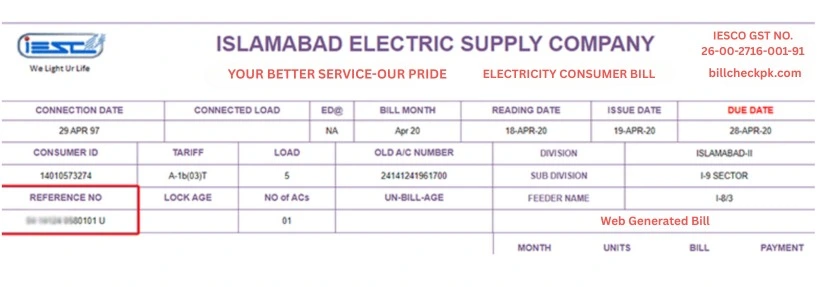
Every Charge on Your IESCO Bill Decoded (2026 Updated)
The 2026 tariff restructuring introduced several new billing components that most consumers don’t understand. Here is every line item explained:
1. Energy Charges (Variable — Units × Slab Rate)
The core charge based on units consumed multiplied by the applicable per-unit rate for your consumption slab and Protected/Unprotected status. IESCO’s progressive slab system means crossing slab boundaries triggers dramatically different per-unit rates — not just on the extra units, but on your overall effective cost.
2. Fixed Charges (NEW in 2026 — Rs/kW/month)
The most significant 2026 change. Previously, IESCO bills were almost entirely consumption-based. Now, a fixed monthly charge based on your sanctioned load (in kW) is applied regardless of how much electricity you actually use. This means even a household consuming zero units in a given month still receives a bill for fixed charges.
| Sanctioned Load | Approximate Fixed Charge |
|---|---|
| Up to 1 kW | Rs. 200/kW/month |
| 1-3 kW | Rs. 350/kW/month |
| 3-5 kW | Rs. 500/kW/month |
| Above 5 kW | Rs. 675+/kW/month |
Critical implication: If your sanctioned load is higher than what you actually need (common in older connections), you are paying unnecessary fixed charges every month. Reviewing and potentially reducing your sanctioned load through an IESCO application can produce immediate permanent savings.
3. Protected vs. Unprotected Consumer Status
The 2026 tariff introduces a clear bifurcation:
Protected Consumers: Typically those with sanctioned load up to 5 kW and consumption patterns below specific thresholds. They receive substantially lower per-unit rates — effectively a subsidy mechanism for lower-consumption households.
Unprotected Consumers: Those exceeding Protected thresholds. Their per-unit rates start at Rs. 22.44 (for even the lowest slab) and climb rapidly to Rs. 47+ for upper slabs. The difference between Protected and Unprotected rates at the same consumption level can be Rs. 10-15 per unit — translating to thousands of rupees on a monthly bill.
How to check your status: Your Protected/Unprotected classification appears on your bill near the tariff category. If you believe you’ve been incorrectly classified, file a dispute through IESCO’s complaint system.
4. Fuel Price Adjustment (FPA)
A monthly variable determined by the Central Power Purchasing Agency (CPPA-G) based on national average fuel costs for electricity generation. FPA can add Rs. 2-8 per unit to your effective rate depending on the month. In months when generation costs drop (rare in 2024-2026), FPA can appear as a negative credit.
5. Quarterly Tariff Adjustment (QTA)
A periodic reconciliation charge capturing cost variances not covered by monthly FPA. Not every bill includes QTA — it depends on the applicable quarter and NEPRA determination.
6. Tariff Rationalization (TR) Surcharge
A separate surcharge introduced during tariff restructuring to fund gap between approved tariff and actual cost of service. Applied as a per-unit addition to energy charges.
7. Finance Cost (FC) Surcharge
Funds infrastructure financing costs — power plant debt servicing, transmission upgrades, grid expansion. Applied as a fixed percentage on energy charges.
8. General Sales Tax (GST)
Applied at 17% on the subtotal of energy charges and applicable surcharges (note: IESCO territory applies 17% GST compared to 18% in some other jurisdictions). GST compounds on already-elevated upper-slab charges, making it one of the most significant cost amplifiers on high-consumption bills.
9. Meter Rent
A fixed monthly fee for the electricity meter installed at your premises. Varies by meter type (analog, digital, smart, TOU).
10. Television License Fee
Flat annual fee (approximately Rs. 35/month) collected through electricity bills for households with licensed television sets.
11. Late Payment Surcharge (LPS)
If payment is made after the due date, a surcharge of 5-10% is applied depending on delay duration. This appears on the next bill as an additional charge. Avoiding LPS through timely online checking and payment is one of the easiest “savings” available.
IESCO Residential Tariff Slabs — Complete 2026 Structure
Protected Consumers (Up to 5 kW Sanctioned Load)
| Monthly Consumption | Per Unit Rate (2026) | Category |
|---|---|---|
| 1-50 units | Rs. 3.95 | Lifeline |
| 51-100 units | Rs. 7.74 | Lifeline |
| 101-200 units | Rs. 13.01 | Lower domestic |
| 201-300 units | Rs. 33.10 | Mid domestic |
| 301-400 units | Rs. 36.50 | Upper domestic |
| 401-500 units | Rs. 40.75 | High consumption |
| 501-700 units | Rs. 43.40 | Very high consumption |
| Above 700 units | Rs. 47.20 | Maximum slab |
Unprotected Consumers
| Monthly Consumption | Per Unit Rate (2026) | Category |
|---|---|---|
| 1-100 units | Rs. 22.44 | Base unprotected |
| 101-200 units | Rs. 26.30 | Lower unprotected |
| 201-300 units | Rs. 30.50 | Mid unprotected |
| 301-400 units | Rs. 36.75 | Upper unprotected |
| 401-500 units | Rs. 41.20 | High unprotected |
| 501-700 units | Rs. 44.50 | Very high unprotected |
| Above 700 units | Rs. 47.85 | Maximum unprotected |
Time-of-Use (TOU) Rates (Mandatory for 5 kW+ Load)
| Period | Per Unit Rate (2026) |
|---|---|
| Peak Hours | Rs. 46.85 |
| Off-Peak Hours | Rs. 34.53 |
Critical Slab Boundaries to Monitor
100 → 101 units (Protected): Rate jumps from Rs. 7.74 to Rs. 13.01 (+68%)
200 → 201 units (Protected): Rate jumps from Rs. 13.01 to Rs. 33.10 (+154%)
Protected → Unprotected threshold: Rate effectively doubles or triples on equivalent consumption
The 200-unit boundary for Protected consumers is the single most devastating cliff-edge in the entire IESCO tariff structure. A household consuming 201 units pays dramatically more than one consuming 199 units — not just on those 2 extra units, but through the cascading effect on the entire bill calculation.
IESCO Coverage Area: 2.8+ Million Consumers Across 6 Districts
IESCO distributes electricity across a diverse service territory spanning urban federal capital, military installations, industrial zones, agricultural districts, and parts of Azad Kashmir:
| District/Region | Key Areas Covered |
|---|---|
| Islamabad | All sectors (F, G, H, I, E, D), DHA, Bahria Town, rural areas |
| Rawalpindi | City, Cantt, Gujar Khan, Taxila, Kahuta, Kallar Syedan, Murree |
| Attock | Attock City, Hazro, Fateh Jang, Jand, Pindi Gheb |
| Jhelum | Jhelum City, Dina, Sohawa, Pind Dadan Khan |
| Chakwal | Chakwal City, Talagang, Choa Saidan Shah, Kallar Kahar |
| AJK (Partial) | Areas from Indus River to Neelum River |
Infrastructure (2026 Figures)
- Total consumers served: 2.8+ million
- Operational circles: 6
- Subdivisions: 110+
- Grid stations: 85+
- Active feeders: 1,400+
- Transmission/distribution lines: ~32,000 km
- Daily units distributed: ~28 million kWh (peak summer)
Peak Hours & Time-of-Use Strategy for 2026
With TOU metering now mandatory for all connections with 5 kW+ sanctioned load, understanding peak/off-peak timing is essential for bill management.
IESCO Peak Hour Schedule (Seasonal)
| Season | Peak Hours | Off-Peak Hours |
|---|---|---|
| Winter (Dec-Feb) | 5:00 PM – 9:00 PM | All other hours |
| Summer (Jun-Aug) | 7:00 PM – 11:00 PM | All other hours |
| Shoulder (Mar-May, Sep-Nov) | 6:00 PM – 10:00 PM | All other hours |
The TOU Mathematics
Peak rate: Rs. 46.85/unit
Off-peak rate: Rs. 34.53/unit
Difference: Rs. 12.32/unit
For a household consuming 300 units monthly:
- If 60% consumed during peak: Total ≈ Rs. 12,547
- If 30% consumed during peak: Total ≈ Rs. 11,436
- Monthly savings from shifting to 30% peak: Rs. 1,111
Over 12 months, strategic peak-hour management saves Rs. 13,000+ annually — before factoring in slab boundary effects.
12 Proven Strategies to Reduce Your IESCO Bill by 30-45%
Strategy 1: Maintain Protected Consumer Status
The single most impactful financial decision. Monitor your consumption actively to stay within Protected thresholds. The rate difference between Protected and Unprotected at equivalent consumption levels can be Rs. 10-15 per unit — translating to Rs. 3,000-15,000 monthly on mid-to-high consumption bills.
Strategy 2: Optimize Your Sanctioned Load
Your sanctioned load determines your Fixed Charges (Rs. 200-675+/kW/month). If your actual maximum demand is lower than your sanctioned load, visit an IESCO customer center and apply for load reduction. The one-time application fee is far less than the permanent monthly savings in Fixed Charges.
Example: Reducing sanctioned load from 5 kW to 3 kW saves approximately Rs. 1,125/month in Fixed Charges alone = Rs. 13,500/year.
Strategy 3: Master Peak/Off-Peak Scheduling
For TOU-metered connections (5 kW+), shift 70% of heavy electrical usage to off-peak hours. This includes water heating, washing machines, dishwashers, electric irons, water pumps, and EV charging. The Rs. 12.32/unit difference between peak and off-peak rates makes this the highest-return behavioral change available.
Strategy 4: LED + Smart Lighting
Replace every incandescent and CFL bulb with LED equivalents. Add motion sensors for hallways, bathrooms, and outdoor areas. Install programmable timers for decorative lighting. Potential savings: 70-80% of lighting electricity costs — typically Rs. 800-2,500/month depending on household size.
Strategy 5: AC & Cooling Efficiency
Islamabad’s continental climate creates 4-5 months of heavy cooling demand. Optimization protocol:
- Set thermostat to 25-26°C (each degree below 25°C increases consumption by 6-8%)
- Clean AC filters monthly during summer
- Use ceiling fans first, AC only when necessary
- Close curtains on sun-facing windows during peak heat
- Seal door and window gaps to prevent cool air escape
Potential savings: 30-40% of cooling costs = Rs. 3,000-12,000/month during summer.
Strategy 6: Refrigerator Discipline
Refrigerators run 24/7 and typically account for 15-25% of residential electricity consumption:
- Position away from heat sources (stove, direct sunlight, walls without ventilation)
- Maintain 3-4°C fridge temperature and -18°C freezer temperature
- Defrost regularly if not frost-free
- Minimize door opening frequency and duration
- Don’t overload or underload (both reduce efficiency)
- Consider upgrading to inverter refrigerator (30-45% consumption reduction)
Strategy 7: Eliminate Phantom Load
Devices in standby mode collectively draw 5-10% of household electricity:
- TVs, set-top boxes, gaming consoles
- Microwave ovens (display clock draws continuous power)
- Phone and laptop chargers (draw power even when not charging)
- Desktop computers and monitors
- Wi-Fi routers (consider scheduling off during sleeping hours)
Solution: Plug all standby-prone devices into switchable power strips. One switch cuts all phantom load. Savings: Rs. 500-1,200/month.
Strategy 8: Water Heater Management
Electric geysers are among the highest single-appliance consumers:
- Install a timer to run only 30 minutes before needed
- Insulate hot water pipes to reduce heat loss
- Consider solar water heating (Islamabad has excellent solar irradiance)
- Set thermostat to 60°C maximum (higher wastes energy)
Potential savings: Rs. 1,500-4,000/month during winter.
Strategy 9: Power Factor Improvement
For commercial and industrial IESCO connections, poor power factor results in penalty charges. Installing capacitor banks improves power factor, reduces reactive power charges, and can lower your effective rate by 10-15%.
Strategy 10: Home Insulation
Islamabad’s temperature extremes (0-45°C annual range) make insulation critically important:
- Seal window and door gaps with weatherstripping
- Install thermal curtains on large windows
- Apply reflective roof coating (reduces roof heat absorption by 30%)
- Add false ceiling insulation if possible
Strategy 11: Regular Meter Testing
If your bill seems abnormally high despite unchanged consumption habits, you have the right to request a free meter accuracy test from IESCO. Contact your local subdivision office with your reference number and request testing. IESCO is mandated to test within 5-7 working days and adjust billing if meter error is confirmed.
Strategy 12: Monthly Online Monitoring
Check your IESCO bill online immediately when generated — don’t wait for the paper bill. Compare consumption against previous months. Track your trajectory relative to slab boundaries. Adjust behavior proactively rather than reactively.
Realistic outcome: Consistent application of strategies 1-12 produces 30-45% bill reduction within 2-3 billing cycles.
How to Download Your IESCO Duplicate Bill
Method 1: Official PITC Portal
Visit bill.pitc.com.pk/iescobill → enter reference number → view bill → download as PDF.
Method 2: IESCO Official Website
Visit iesco.com.pk → “Get Duplicate Bill” → enter consumer details → download.
Method 3: Enhanced Third-Party Platforms
Trusted verification platforms offering additional features: bill history for 12-24 months, consumption trend graphs, slab analysis, and downloadable records in PDF and image formats.
Method 4: IESCO SMS Service
Register your mobile number through IESCO’s official website for automatic bill generation alerts. When the alert arrives, use the checker tool to download immediately.
Best practice: Save every bill PDF digitally in a dedicated folder. These records are invaluable for dispute resolution, tax documentation, and consumption trend analysis.
9 IESCO Bill Payment Methods (2026 Updated)
Digital Payment Channels (Recommended)
| Method | Processing Time | Fee |
|---|---|---|
| Mobile Banking Apps (HBL, UBL, Meezan, Alfalah, MCB, Askari) | Instant to 2 hours | Free |
| JazzCash | Instant | Free or minimal |
| Easypaisa | Instant | Free or minimal |
| NayaPay / SadaPay | Instant | Free |
| Internet Banking (browser-based) | Instant to 4 hours | Free |
| ATM Bill Payment | Instant to 24 hours | Free |
| 1Bill / NIFT ePay | Instant | Varies |
Physical Payment Channels
| Method | Processing Time | Fee |
|---|---|---|
| Bank Branch Counter | Same day to next business day | Free |
| Pakistan Post | 1-2 business days | Free |
| IESCO Customer Service Centers | Immediate posting | Free |
Always keep transaction ID/receipt until payment reflects in your account (typically within minutes to 24 hours).
Common IESCO Bill Problems & Solutions
Problem 1: Unexpectedly High Bill
Solution path:
- Check your Protected/Unprotected status on the bill
- Verify sanctioned load matches your actual connection
- Compare current units consumed with previous 3 months
- Check if FPA/QTA adjustments spiked this month
- If meter error suspected, request free testing via local subdivision
Problem 2: Paper Bill Not Received
Solution path:
- Switch to digital alerts immediately via IESCO SMS registration
- Check bill online using reference number every month
- Download and save PDF duplicate
Problem 3: Name/Address Errors
Solution path:
Visit nearest IESCO customer service center with original CNIC and proof of correct address. Corrections typically process within 7-10 working days.
Problem 4: Payment Not Reflecting
Solution path:
- Keep receipt/transaction ID as proof
- Wait 48 hours for system processing
- If still not reflected, contact IESCO helpline 051-9252937 with payment proof
- Alternatively, visit customer service center with receipt
Problem 5: Reference Number Not Working Online
Solution path:
- Try both 14-digit reference number AND 10-digit customer ID
- Clear browser cache and try again
- Try a different browser or device
- If persistent, contact IESCO helpline for account verification
IESCO Meter Types in 2026
| Meter Type | Description | Reading Method | TOU Capable |
|---|---|---|---|
| Analog | Spinning disc, older properties | Manual by meter reader | ❌ No |
| Digital | LCD display, standard since 2010s | Manual by meter reader | ❌ No |
| TOU Meter | Separate peak/off-peak registers | Manual with TOU reading | ✅ Yes |
| Smart (AMI) | Communication module equipped | Automatic remote reading | ✅ Yes |
| Net Meter | Bidirectional for solar users | Automatic (import+export) | ✅ Yes |
Identification guide:
- Spinning disc visible = Analog
- LCD numeric display without antenna = Digital
- Two separate reading registers = TOU
- Visible antenna/communication module = Smart
- Two display counters (import/export) = Net
2026 mandate: All connections with 5 kW+ sanctioned load must have TOU-capable meters. If yours is still analog or basic digital, contact IESCO for upgrade scheduling.
How to File an IESCO Billing Complaint
Channel 1: IESCO Online Complaint Portal
Visit iesco.com.pk → Consumer Services → Complaint Registration → enter consumer details → select category → submit → receive tracking number.
Channel 2: Consumer Helpline
Call 051-9252937 during working hours. Describe issue. Request complaint reference number.
Channel 3: Emergency Fault Line
Call 118 (toll-free, 24/7) for immediate power outage or safety emergency situations only.
Channel 4: CEO Complaint Cell
For escalated complaints not resolved through standard channels, use the official CEO complaint email available on the IESCO website.
Resolution Timeframes
| Complaint Type | Expected Resolution |
|---|---|
| Billing errors/overcharging | 7-10 working days |
| Physical meter faults | 24-48 hours |
| Meter accuracy retesting | 5-7 working days |
| Tariff category correction | 15-20 working days |
| New connection issues | 30-45 working days |
| Load management complaints | 10-15 working days |
If unresolved within stated timeframe, escalate to NEPRA’s consumer complaint portal which has regulatory jurisdiction over all Pakistani distribution companies including IESCO.
IESCO Bill Security: Identifying Scams & Protecting Your Data
Red Flags for Fake IESCO Bill Websites
- ❌ Asks for credit card number, CVV, or bank account details
- ❌ Requests CNIC photo upload for “bill verification”
- ❌ No HTTPS connection (no padlock icon)
- ❌ Offers “bill discount” in exchange for personal information
- ❌ Pop-ups claiming you’ve won prizes
- ❌ URLs mimicking official sites with slight spelling variations
- ❌ Grammatical errors and mismatched IESCO branding
What IESCO Will Never Do
- ❌ Phone you asking for banking credentials
- ❌ Email payment links to unknown addresses
- ❌ Run “discount schemes” requiring third-party payment
- ❌ Send SMS demanding OTP codes for “bill adjustment”
The Broader Identity Protection Connection
Your CNIC doesn’t just link to your IESCO account. It simultaneously links to your mobile SIMs (PTA database), banking accounts, tax records, vehicle registration, and government services. Identity fraud often spans multiple systems — criminals who obtain your CNIC may register unauthorized utility connections AND SIM cards simultaneously.
This is why comprehensive identity protection requires monitoring all CNIC-linked services monthly — including your IESCO bill, your SIM registrations (via PTA code 668), and your NADRA records. The same “verify through official channels only, never pay for free services” principle applies across all platforms.
For the complete framework covering SIM verification, CNIC protection, and mobile identity security using the same trusted-source methodology, our comprehensive SIM Owner Details resource provides everything Pakistani citizens need for 2026.
IESCO Contact Directory — 2026 Complete Reference
| Contact Channel | Details |
|---|---|
| Consumer Helpline | 051-9252937 (working hours) |
| Emergency Fault Line | 118 (toll-free, 24/7) |
| Head Office | Street #40, Sector G-7/4, Islamabad |
| Official Website | iesco.com.pk |
| Bill Portal | bill.pitc.com.pk/iescobill |
| CEO Complaint Cell | Via official email on website |
| Customer Service Centers | All 6 circles + 110+ subdivisions |
| Emergency Response | 24/7 via 118 |
Beyond IESCO: Complete Pakistani Citizen Services Platform
Effective household financial and identity management in 2026 requires monitoring all CNIC-linked services comprehensively. Our platform provides instant verification tools for:
All Pakistani Electricity Distribution Companies:
LESCO (Lahore) • FESCO (Faisalabad) • GEPCO (Gujranwala) • MEPCO (Multan) • HESCO (Hyderabad) • PESCO (Peshawar) • QESCO (Quetta) • K-Electric (Karachi) • TESCO (Tribal Areas) • AJ&K Electricity
Identity Verification & Protection Tools:
SIM Owner Details — PTA-sanctioned SIM verification (668, 667, sims.pk, operator-specific codes), CNIC Information checking, SIM Database access, Live Tracker verification, Pak SIM Data resources, and complete mobile identity protection guides.
Each service follows the same methodology: official data sources only, zero fraud risk, completely free, and designed to give Pakistani citizens complete control over their identity and financial footprint.
Your IESCO Bill Action Plan: From Passive Consumer to Active Cost Manager
Right Now (5 Minutes)
- Locate your 14-digit IESCO reference number from any previous bill
- Check your current bill online
- Note: total units consumed, which slab you’re in, Protected/Unprotected status, sanctioned load
Today (30 Minutes)
- Download current bill PDF for records
- Register for IESCO SMS notification service
- Read your physical meter and note current reading
- Calculate units consumed so far this billing cycle
- Review your sanctioned load — is it higher than needed?
This Week
- Identify your meter type (analog/digital/TOU/smart/net)
- Calculate average daily consumption rate
- Estimate whether you’ll cross a slab boundary before cycle ends
- If approaching Protected/Unprotected threshold — reduce usage immediately
- Audit heavy appliances for energy efficiency potential
Every Month (60 Seconds)
- Check IESCO bill online the day it’s generated
- Verify meter reading against your own tracking
- Confirm tariff category and Protected status are correct
- Pay before due date to avoid 5-10% surcharge
- Save PDF duplicate for records
Annually
- Review 12-month consumption trend
- Evaluate sanctioned load optimization
- Consider TOU meter installation (if eligible and not yet installed)
- Assess solar net metering ROI for your consumption level
- Verify no unauthorized IESCO connections exist under your CNIC
Last verified and updated: 11 May 2026 — Tariff rates, fixed charges, slab structures, and regulatory references reflect current NEPRA-approved notifications. Tariffs are subject to mid-year revision through NEPRA determinations and monthly FPA/QTA adjustments — always verify against your specific bill for exact figures.
For Pakistan’s most trusted free platform covering telecom verification, SIM identity protection, CNIC information, and all utility bill services, explore SIM Owner Details — your complete citizen services resource for 2026.
 SIM OWNER DETAILS