
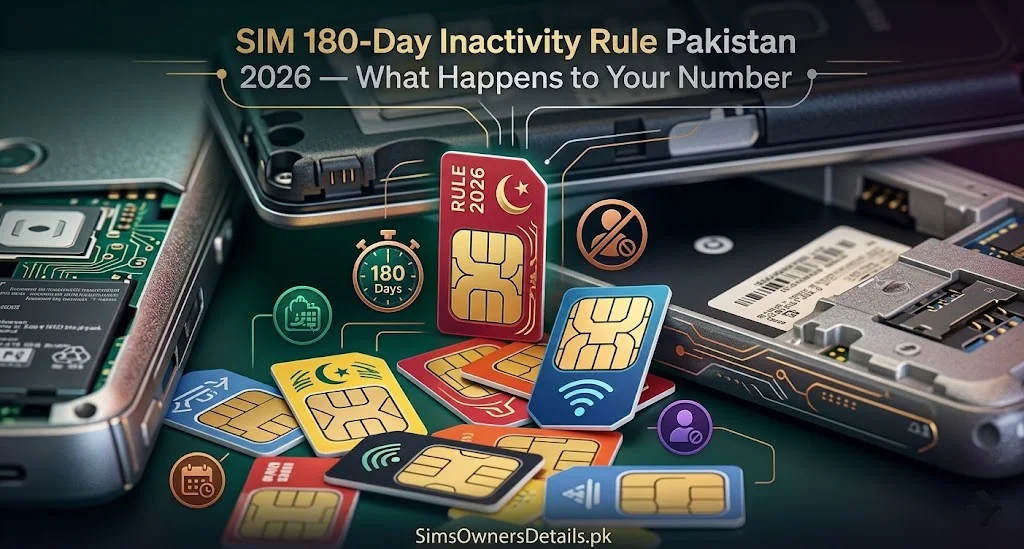
Pakistan’s telecom regulations include a critically important but widely misunderstood rule that affects every SIM holder in the country: if a SIM card remains completely inactive for 180 consecutive days, the operator has the right to deactivate it — and eventually recycle the number for registration to a new subscriber.
For most active users, this rule is invisible because they use their SIMs regularly. But it becomes critically important in specific situations — long stays abroad, hospitalization, secondary SIMs left unused, SIMs owned by elderly relatives, or numbers kept as backup but rarely used. This guide explains exactly how the 180-day inactivity rule works, what “activity” counts, what happens to your CNIC record when a SIM deactivates, and how to prevent or recover from accidental deactivation.
Quick Answer: A SIM in Pakistan that has no outgoing activity (calls, SMS, or data usage) for 180 consecutive days can be deactivated by the operator. Incoming calls and SMS do not count as activity. To keep a SIM active, make at least one outgoing call, send one SMS, or use any mobile data every 180 days.
What Is Pakistan’s 180-Day SIM Inactivity Rule?
The 180-day inactivity rule is a PTA-regulated policy applied by all Pakistani mobile operators — Jazz, Zong, Telenor, Ufone, and SCO. Under this policy:
- A SIM that shows no outgoing activity for 180 consecutive days enters a “dormant” or “inactive” status
- After dormancy, operators may suspend the SIM (incoming and outgoing blocked)
- Following a further grace period (typically 30–90 days), the number may be permanently deactivated
- After permanent deactivation, the number can be recycled — reissued to a completely different person
Why this rule exists:
- Operators need to manage limited number ranges in Pakistan’s mobile ecosystem
- Inactive SIMs consume database resources and number capacity
- PTA requires operators to maintain accurate, live SIM registrations
- The rule encourages CNIC registration cleanup — abandoned numbers return to the pool
What “activity” means under this rule: Any outgoing action counts as activity:
- Making or attempting to make a phone call (even unanswered)
- Sending an SMS
- Using mobile internet data (any amount)
- Making any USSD code query (e.g., *100# to check your own number)
What does NOT count as activity:
- Receiving incoming calls
- Receiving incoming SMS
- Receiving promotional messages from the operator
- Having the SIM inserted in a phone but not used
- Having balance on the SIM but not spending it
The Deactivation Timeline — What Actually Happens Step by Step
Understanding the exact timeline helps you intervene before permanent deactivation occurs:
Day 1–180: Active Period
Your SIM is fully active as long as any outgoing activity occurs at least once during this window.
Day 180: Dormancy Trigger
If 180 full days pass with no outgoing activity, your SIM enters dormant status in the operator’s system.
Day 181–210 (approx.): Warning Phase
Most operators send warning SMS messages to your SIM during this period:
- “Your SIM has been inactive. Please use it within [X] days to prevent deactivation.”
- These warnings are sent to the SIM itself — meaning you receive them only if your phone is powered on with the SIM inserted
Action at this stage: Any outgoing activity (one call, one SMS, one USSD query) immediately resets the inactivity counter and restores full active status.
Day 210–270 (approx.): Suspension Phase
If no activity occurs despite warnings, the operator may suspend your SIM:
- Outgoing calls and SMS are blocked
- Incoming calls and SMS may still work (operator-specific)
- USSD queries are typically still accessible
- Your SIM remains on your CNIC in the 668 database
Action at this stage: Visit the operator’s franchise with your CNIC to reactivate the SIM. A small reactivation fee may apply.
Day 270–365 (approx.): Permanent Deactivation
If no reactivation occurs, the number is permanently deactivated:
- The SIM no longer works for any function
- The number is removed from your CNIC’s registration count in PTA’s database
- Your CNIC’s 5-SIM quota gains one free slot
After Permanent Deactivation: Number Recycling
After a quarantine period (typically 6–12 months from deactivation), the number may be reissued:
- The number is registered under a completely new person’s CNIC
- Your old number is no longer linked to you in any system
- Anyone who contacts that number reaches a different person
How the 180-Day Rule Affects Your CNIC’s SIM Count
This is where the 180-day rule has significant implications for your identity security:
When your SIM deactivates: The number disappears from your 668 check results. Your CNIC’s SIM count decreases by one.
Positive implication: If you have unused SIMs on your CNIC consuming slots, their natural deactivation frees up quota for new registrations.
Negative implication: If the deactivated number is one you actually want — even if you forgot to use it — it is now potentially recycled to someone else.
Security concern: After a number is recycled and reassigned to a new person, that person effectively “inherits” any accounts still linked to that number — WhatsApp, OTP-based banking that has not been updated, old app registrations. This is not fraud by the new owner — but it creates security vulnerabilities for the original owner.
Critical action: Before a number is recycled, update any accounts linked to that number — WhatsApp, bank OTP settings, two-factor authentication — to your current active number.
For a complete understanding of how your CNIC’s SIM count is managed across all networks, visit our CNIC information guide.
Which SIMs Are Most at Risk of the 180-Day Deactivation
Identify whether any of your SIMs are vulnerable:
High Risk:
Backup SIMs: Secondary numbers kept “just in case” but rarely used. These are the most common casualties of the 180-day rule.
Data-only SIMs: SIMs used only for internet in a dedicated data device. If the device is not used regularly, the SIM can hit 180 days of inactivity.
SIMs of people abroad: Overseas Pakistanis often leave a Pakistani SIM at home or in storage. Six months passes quickly — especially during longer stays abroad.
Elderly relatives’ SIMs: Elderly family members who do not regularly use their phones, or who use only landlines for communication.
SIMs registered for occasional use: Festival-period top-up numbers, SIMs bought for specific trips, and similar occasional-use numbers.
Lower Risk:
Primary SIMs: Numbers used daily for calls, messages, and internet — will never hit 180 days without activity.
WhatsApp-only SIMs: If you have a SIM registered specifically for WhatsApp, note that WhatsApp’s background activity (receiving messages) does NOT count as outgoing activity for the operator’s inactivity calculation. You must make an actual outgoing call or send an SMS separately.
How to Prevent SIM Deactivation — All Methods
Method 1: Set a Calendar Reminder (Most Reliable)
For every secondary or backup SIM:
- Set a recurring calendar reminder every 90 days (well within the 180-day limit)
- When the reminder triggers, make one outgoing call from the SIM (even a 5-second test call)
- The inactivity counter resets immediately
Method 2: Use USSD Codes (Easiest, No Balance Needed)
USSD queries count as outgoing activity and require no balance:
- Jazz: Dial
*100#(own number check) - Zong: Dial
*100# - Telenor: Dial
*9# - Ufone: Dial
*99#
One USSD query every 90 days keeps your SIM fully active.
Method 3: Auto-Recharge Setup
Jazz, Zong, and Telenor offer auto-recharge features that automatically recharge your SIM when balance falls below a threshold. An auto-recharge itself may count as account activity depending on the operator — confirm with your operator’s helpline.
Method 4: Send a Test SMS
Send a simple SMS to any active number from your backup SIM every 90 days. Even a single character message counts as outgoing activity.
Method 5: Enable Call Forwarding From Primary to Backup SIM
On some operators, setting up call forwarding FROM your primary SIM TO your backup SIM counts as an outgoing configuration on the backup SIM. Confirm with your specific operator.
How to Recover a Deactivated SIM in Pakistan
If your SIM has already been deactivated, recovery options depend on the stage:
Stage 1: Suspended But Not Permanently Deactivated
If your SIM is suspended (blocked outgoing but operator has not yet permanently deactivated the number):
- Visit the operator franchise with your original CNIC
- Complete biometric verification to confirm ownership
- Request reactivation
- Pay any applicable reactivation fee (typically nominal — Rs. 50–200)
- SIM is reactivated within the same day
How to confirm your SIM is suspended vs permanently deactivated: Try dialing a USSD code (*100#). If you get a response — even an error — the SIM is likely still in the system. If there is no response at all, it may be permanently deactivated.
Stage 2: Permanently Deactivated But Number Not Yet Recycled
If the number has been permanently deactivated but the operator’s quarantine period has not expired:
- Visit the operator franchise with your original CNIC immediately
- Some operators allow number recovery within the quarantine period (typically 30–90 days after permanent deactivation)
- You will need to complete biometric verification
- A new SIM with the same number may be issued
- Success depends on operator policy and how recently the deactivation occurred
Call the helpline first before visiting: Jazz 111, Zong 310, Telenor 345, Ufone 333. Ask if your number is still recoverable before making the trip.
Stage 3: Number Recycled to New Owner
If the number has been reissued to a new person:
- Recovery of the original number is not possible
- The number now legally belongs to the new registrant
- Your only options are: accept the loss, or register a new number
- Mitigate the damage: Immediately update all accounts that were linked to the old number — banks, WhatsApp, apps — to your current active number
SIM 180-Day Rule and Overseas Pakistanis
This rule has significant implications for Pakistanis living or working abroad:
The problem: An overseas Pakistani SIM left in Pakistan with no user goes inactive within 180 days. A SIM abroad cannot make outgoing Pakistani calls on the local network (international roaming costs are typically prohibitive for regular use).
Solutions for Overseas Pakistanis:
Option 1: Leave the SIM with a trusted family member Ask a family member to make one outgoing call or USSD query from your Pakistani SIM every 90 days. Simple and free.
Option 2: Use international roaming (selective) Every 5 months, use your Pakistani SIM on international roaming to make one call to a Pakistani number. This counts as outgoing activity and resets the counter. Note: international roaming may require activation before departure.
Option 3: Transfer the SIM temporarily If you are leaving for a long period, you can arrange for a trusted family member to use the SIM number (with your consent) — their activity keeps it active.
Option 4: Accept deactivation and recover on return If the SIM deactivates while you are abroad, visit the franchise immediately on your return before the quarantine period ends (typically 30–90 days after permanent deactivation).
Frequently Asked Questions — SIM 180-Day Inactivity Rule Pakistan
Q: Does receiving a call or SMS count as activity under the 180-day rule?
A: No. Strictly outgoing activity counts — outgoing calls, outgoing SMS, or any mobile data usage. Receiving incoming calls and messages does not reset the inactivity counter.
Q: My SIM shows no signal — is it deactivated or just a network issue?
A: Try inserting the SIM in a different phone to rule out handset issues. Try in an area with confirmed network coverage. If still no signal, call the operator’s helpline from a different number to check your SIM’s status.
Q: If my backup SIM deactivates, does my CNIC’s 5-SIM count reduce by one?
A: Yes. A permanently deactivated SIM is removed from your CNIC count in PTA’s database. You gain one free registration slot.
Q: Can I reactivate a deactivated SIM without visiting a franchise?
A: In some cases, operators allow reactivation via their helpline (a new SIM kit is dispatched). However, biometric verification is required for any SIM reactivation, which typically requires a franchise visit. Call your operator’s helpline to check what options are available for your specific situation.
Q: Does a fraudulently registered SIM on my CNIC also deactivate after 180 days of inactivity?
A: Yes — if the criminal who registered the fraudulent SIM stops using it, it will deactivate after 180 days. However, do NOT rely on this as a fraud resolution strategy — always report unauthorized SIMs immediately rather than waiting for natural deactivation.
Q: If I top up my SIM balance but don’t make any calls, does the top-up count as activity?
A: No. Topping up balance is a financial transaction, not outgoing activity. You must actually use the SIM for outgoing communication — even a single USSD query is sufficient.
Q: My SIM deactivated while I was abroad and the number was recycled. Is there any way to alert the new owner of accounts still linked to my old number?
A: Unfortunately, no direct mechanism exists. Your best course is to proactively update every account — banks, WhatsApp, apps — to a new active number as soon as you know the old number was recycled. Monitor your financial accounts for any unauthorized access.
Q: Does the 180-day rule apply to corporate/business SIMs registered under company NTN? A: Yes. The 180-day inactivity rule applies to all SIM types in Pakistan — personal and corporate. Business SIMs that are not regularly used (backup numbers, seasonal business numbers) are equally subject to deactivation.
Summary — SIM 180-Day Inactivity Rule Pakistan
| Stage | Days | Status | Action Required |
|---|---|---|---|
| Active | 0–179 | Fully active | None |
| Warning | ~180–210 | Dormant — warnings sent | Make one outgoing call/SMS |
| Suspended | ~210–270 | Outgoing blocked | Visit franchise for reactivation |
| Deactivated | ~270–365 | Permanently off | Franchise recovery (if in quarantine) |
| Recycled | 365+ | New owner assigned | Accept loss — update linked accounts |
The prevention solution is simple: A single USSD query (e.g., *100#) every 90 days keeps any SIM permanently active. Set a recurring reminder and never lose a number to inactivity again.
For all SIM verification tools, CNIC protection guides, and Pakistan’s complete mobile identity security resource library, visit Sim Owner Details — and explore the SIM info guide for everything you need to know about managing your SIM registrations in 2026.
Related Guide:
 SIM OWNER DETAILS
1 thought on “SIM 180-Day Inactivity Rule Pakistan 2026 — What Happens to Your Number”