
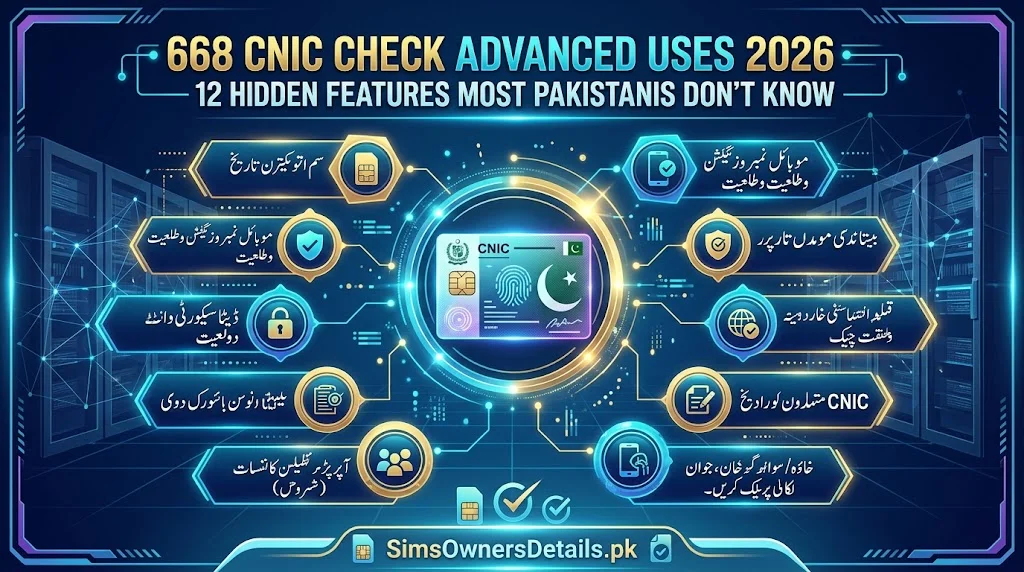
Most Pakistanis who know about the 668 service use it in only one way: they send their CNIC number, get a list of SIMs, confirm everything looks correct, and move on. This basic use is valuable — but it represents a fraction of what the 668 service can do for you when used strategically and systematically.
The 668 system is Pakistan’s live window into the national SIM registration database. When used beyond the simple monthly check, it becomes a powerful multi-purpose security and verification tool — for fraud detection, legal documentation, family protection, pre-transaction verification, financial security, and business continuity. This guide reveals all 12 advanced uses of the 668 CNIC check that most Pakistani mobile users have never considered.
Before the advanced uses: If you are not yet using 668 for basic monthly monitoring, start there first. Send your 13-digit CNIC (no dashes) to 668 from any Pakistani SIM, free, and get your current SIM list in 60 seconds. Every advanced use builds on this foundation.
Advanced Use 1: Pre-Transaction Security Check Before Financial Activity
Most SIM swap fraud occurs when a criminal registers a new SIM on your CNIC specifically to intercept your OTPs before a financial transaction. The window between registration and attack can be as short as 30 minutes.
The advanced technique: Before initiating any significant financial transaction — a large bank transfer, a JazzCash withdrawal, an Easypaisa payment above a threshold — send your CNIC to 668 first.
Why this works: If a criminal has registered a new SIM on your CNIC specifically to intercept your transaction OTP, it will appear in the 668 results before the OTP arrives. This 60-second check could be the difference between completing your transaction safely and losing your funds.
Implementation:
- Set a personal rule: before any transfer above Rs. 10,000 (or your own threshold), run a 668 check
- If 668 shows only known SIMs — proceed with the transaction
- If 668 shows a new unfamiliar SIM — halt the transaction, call PTA 0800-55055 immediately, and freeze the transaction from your bank’s fraud line
Estimated time cost: 60 seconds per transaction check. Estimated value: Potentially prevents thousands to lakhs in financial fraud.
Advanced Use 2: Creating a Monthly Screenshot Archive — Your Fraud Timeline
A single 668 check tells you current SIM status. A monthly archive of 668 screenshots tells a story over time — and that story is legal evidence in fraud investigations.
The advanced technique: Every time you perform your monthly 668 check, screenshot the result immediately and save it in a dedicated folder (phone gallery or cloud storage) with the date clearly visible.
What this archive creates:
- A documented timeline of every SIM that appeared on your CNIC
- Proof of exactly when an unauthorized SIM first appeared
- Evidence that you did not have an unauthorized SIM before a specific date
- A record that distinguishes legitimate registrations from fraudulent ones
Legal value:
- For FIA Cybercrime complaints: shows the exact date range of the unauthorized SIM’s existence
- For police FIR: provides a documented timeline that helps investigators narrow down when the fraud registration occurred
- For bank fraud disputes: proves your CNIC’s clean status before the fraud event
Implementation: Create a folder called “668 Checks” in your phone gallery. Every first of the month, send to 668 and screenshot within 5 seconds of receiving the reply. This takes 2 minutes per month and builds a legally valuable record over time.
For a complete understanding of how your SIM registration data is maintained in Pakistan’s national database, visit our Pakistan SIM database guide.
Advanced Use 3: Family CNIC Audit — Protecting Every Member
Most Pakistanis check their own CNIC via 668 but never check other family members’ CNICs. Criminals specifically target family members who are less likely to monitor their own SIM registrations — elderly relatives, overseas workers, young adults who recently got their first CNIC, and even deceased relatives whose CNICs remain in PTA’s database.
The advanced technique: Collect the CNIC numbers of every CNIC holder in your household and run a monthly 668 check for each one.
High-priority family members to check:
| Family Member | Risk Level | Reason |
|---|---|---|
| Elderly parent (60+) | Very High | Less digital awareness, rarely monitor |
| Sibling/child recently got CNIC | High | New CNIC — criminals watch for new registrations |
| Overseas family member | Very High | Cannot monitor themselves from abroad |
| Recently deceased relative | Critical | CNIC remains in system — a fraud goldmine |
| Young adult (18–25) | High | New to monitoring, less experienced |
For deceased family members: A CNIC remains in PTA’s database and can have SIMs registered on it after the holder’s death until NADRA is formally notified. Check deceased relatives’ CNICs and report any findings to NADRA and PTA to ensure the CNIC is properly flagged.
Implementation: Create a “Family 668 Check List” with all household CNICs. Run all checks on the first of each month. It takes under 5 minutes for an entire family.
Advanced Use 4: Pre-SIM Registration Check — Know Your Slot Availability
Before visiting any operator franchise to register a new SIM, run a 668 check to know exactly how many of your 5 available slots are occupied and which operators have your existing SIMs.
Why this matters:
Scenario A: You have 4 SIMs showing on 668 — you have 1 slot remaining. You know before visiting the franchise that you can register exactly one more SIM.
Scenario B: You have 5 SIMs showing on 668, including 2 you do not recognize. You now know before visiting that you need to block the unauthorized ones before you can register a new SIM. This saves you a wasted franchise trip.
Scenario C: You have 5 SIMs on 668 — all yours — but you want a new one. You know before visiting that you must choose which existing SIM to deactivate.
Implementation: Always check 668 before any franchise visit for SIM-related business. It takes 60 seconds and prevents wasted journeys and surprises at the counter.
Advanced Use 5: Post-Transaction Verification — Confirm Your Blocking Was Successful
After successfully blocking an unauthorized SIM through PTA or your operator, most Pakistanis assume the job is done. But blocking can fail silently — or the unauthorized SIM can be re-registered under your CNIC if the fraud network is persistent.
The advanced technique: After any SIM blocking event, conduct systematic verification checks:
Day 2 after blocking request: Send to 668. The blocked SIM should no longer appear.
Day 7: Send to 668 again. Confirm the blocked SIM is still gone and no new unauthorized SIM has appeared.
Day 30: Send to 668. A full month of clean results is your confirmation that the fraud event is fully resolved.
If the blocked SIM reappears: The criminal has re-registered it. File a new PTA complaint immediately and consider requesting PTA to place a registration flag on your CNIC for enhanced scrutiny.
Advanced Use 6: Verifying Your SIM After Biometric Re-Verification
After completing biometric re-verification at a franchise (following a BVS Pending notice), many users wonder whether the update properly registered in PTA’s database. 668 provides the fastest verification.
The advanced technique: After completing biometric re-verification at any franchise:
- Wait 60 minutes for the database update to propagate
- Send your CNIC to 668
- If your SIM appears in the results with the correct network label — BVS completion was successfully recorded
- If your SIM still does not appear after 2 hours — return to the franchise and request confirmation that the BVS submission was properly submitted to PTA
This ensures you do not get a PTA blocking notice later due to a BVS submission error by the franchise.
Advanced Use 7: Pre-CNIC-Sharing Baseline Check
Before sharing your CNIC for any purpose — hotel check-in, bank account opening, employer HR onboarding, new SIM registration — establish a baseline with 668.
The advanced technique:
- Before sharing your CNIC: send to 668 and screenshot (Baseline screenshot)
- Share your CNIC for the intended purpose
- 48 hours later: send to 668 again and screenshot (Post-sharing screenshot)
- Compare: any new SIM in the post-sharing screenshot that was not in the baseline is directly traceable to the sharing event
Why this is powerful: If you discover an unauthorized SIM after sharing your CNIC with a hotel, for example, you have:
- A timestamped baseline screenshot showing your CNIC was clean before the sharing
- A post-sharing screenshot showing when the unauthorized SIM appeared
- A specific institution identified as the likely source of the fraud
This is significantly stronger evidence for FIA investigations than a simple complaint without a traceable timeline.
Advanced Use 8: Network-Specific Analysis for SIM Slot Planning
Beyond counting total SIMs, the 668 reply shows which network each SIM is on. This information is useful for strategic SIM slot management:
The advanced technique: Use your 668 results to make informed decisions about SIM portfolio:
Example analysis from a 668 reply:
- 2 Jazz SIMs (one personal, one JazzCash dedicated)
- 1 Zong SIM (primary data SIM for 5G)
- 1 Telenor SIM (Easypaisa dedicated)
- Total: 4 SIMs — 1 slot remaining
Strategic insight: You have 1 slot remaining. You use both Jazz slots for different purposes and both financial wallets are on separate SIMs. If you want a 5th SIM, you know it is available and can plan accordingly.
Another common scenario: Your 668 shows a Telenor SIM you forgot about from years ago that you no longer use. It is consuming a slot. Deactivating it frees a slot for a more useful SIM.
Advanced Use 9: Pre-Overseas Travel SIM Security Check
Before traveling abroad, run a comprehensive 668 check and establish your travel security protocol:
The advanced technique:
Step 1 — Pre-departure check: Send to 668 one day before leaving Pakistan. Screenshot results.
Step 2 — Contact instructions for family: Give a trusted family member your CNIC number and ask them to run 668 checks every 2 weeks while you are abroad.
Step 3 — Access setup: Ensure cnic.sims.pk bookmarked on your device for international monitoring.
Step 4 — SIM inactivity prevention: Confirm the family member will make one USSD query from your left-behind Pakistani SIM every 90 days.
Step 5 — Return check: On returning to Pakistan, run 668 within 48 hours of your hotel check-in registration.
Why the return check matters: Hotel check-in in Pakistan requires CNIC registration. Post-check-in is your highest fraud window. Running 668 within 48 hours of arriving catches any hotel-related SIM fraud before it is exploited.
Advanced Use 10: Legal Complaint Documentation Package
When filing any legal complaint involving SIM fraud — with PTA, police, FIA, or a bank — a well-documented 668 evidence package significantly strengthens your case.
The complete legal documentation package via 668:
Document 1: The original discovery screenshot — your 668 reply that first showed the unauthorized SIM.
Document 2: A baseline screenshot from a recent prior month — proving the unauthorized SIM was not there before.
Document 3: The post-blocking screenshot — your 668 result 48 hours after requesting the block, confirming the block was (or was not) applied.
Document 4: Follow-up screenshots at regular intervals — proving the SIM did not reappear.
How to present this package:
- For PTA complaints: upload as attachments to complaint.pta.gov.pk
- For police FIR: print all screenshots with dates visible or show on device
- For bank fraud disputes: email all screenshots in a single PDF with dates labeled
- For FIA Cybercrime: include in your digital evidence submission
This package transforms your complaint from a verbal claim into a documented evidence trail.
Advanced Use 11: Business Owner Multi-CNIC Monitoring
Business owners who manage teams often share their own CNIC or colleagues’ CNICs for various business registrations, bank account openings, and operator corporate account setups. This creates elevated fraud exposure across multiple CNICs.
The advanced technique for business owners:
- Identify every CNIC that has been shared for business purposes
- Create a monthly monitoring schedule for all of them
- Run 668 for each CNIC on the same day each month
- Use a simple spreadsheet to track: CNIC number, expected SIM count, actual 668 result, discrepancies
Red flags to watch for:
- Any SIM that was not previously appearing
- Any SIM on an unexpected network
- Count exceeding what was authorized
This practice prevents:
- Unauthorized SIM registrations by disgruntled ex-employees
- Insider fraud by current employees with CNIC access
- Corporate identity fraud using company-related CNICs
For Pakistan’s most comprehensive monitoring infrastructure and SIM data verification tools, visit simsownersdetails.pk/pak-sim-data/.
Advanced Use 12: Teaching Family Members to Protect Themselves
The most underutilized advanced application of 668 is using it as a teaching tool — particularly for family members who are less digitally aware but who face equal or greater fraud risk.
The advanced technique — the family education session:
For elderly parents: Sit with them, demonstrate the 668 SMS from their phone, show them what their CNIC’s results look like when clean, and set up a recurring 90-day calendar reminder on their phone with the instruction: “Send [CNIC number] to 668.”
For newly adult children: Teach them 668 as part of their first CNIC orientation — alongside how to use their bank account and how to file a complaint. Make it as fundamental as knowing their own CNIC number.
For overseas family members: Walk them through cnic.sims.pk over a video call. Show them how to check, how to interpret results, and what to do if something unfamiliar appears.
The multiplier effect: Each family member who monitors their own CNIC removes themselves from the fraud risk pool. One hour spent teaching your family how to use 668 could prevent multiple fraud incidents across your household over years.
Frequently Asked Questions — 668 Advanced Uses
Q: How many times per day can I use 668 without being rate-limited?
A: PTA has not published a specific rate limit. For normal monitoring (once daily or less), no throttling applies. For rapid repeated queries (more than 10 in an hour), you may experience slower responses.
Q: Can I use 668 as part of a business security checklist?
A: Yes. Many security-conscious Pakistani businesses include 668 checks as part of their employee onboarding (checking the company-relevant CNIC) and monthly security reviews.
Q: Is there a way to get 668 results as an email instead of SMS?
A: Not currently — 668 is exclusively an SMS-based service. For email-friendly results, use cnic.sims.pk and screenshot for email attachment.
Q: Can I monitor someone else’s CNIC with their consent?
A: The technical answer is yes — you can send any CNIC to 668. The legal answer is that doing so even with consent creates complexity under PECA 2016. The safer approach is to have the person check their own CNIC from their own phone, or to assist them directly with their knowledge and consent present.
Q: My 668 screenshots show dates but the time is not visible. How do I include time?
A: Before screenshotting, ensure your phone’s status bar (where the clock is shown) is visible in the screenshot. Alternatively, open your phone’s clock app in a small window alongside the SMS, or use your phone’s native screenshot-with-annotation feature to add a timestamp.
Q: For the pre-transaction security check (Advanced Use 1), what transaction amount justifies a 668 check?
A: Set your own threshold based on your risk comfort. A reasonable starting point: any transaction above Rs. 5,000 or any transaction involving a new payee/recipient you have not used before.
Summary — 12 Advanced Uses of 668 CNIC Check
| Use Case | Frequency | Time Required |
|---|---|---|
| Pre-transaction security check | Per high-value transaction | 60 seconds |
| Monthly screenshot archive | Monthly | 2 minutes |
| Family CNIC audit | Monthly | 5 minutes (all family) |
| Pre-SIM registration check | Before franchise visit | 60 seconds |
| Post-blocking verification | Day 2, 7, and 30 after blocking | 60 seconds each |
| Post-biometric re-verification | 60 min after franchise visit | 60 seconds |
| Pre-CNIC-sharing baseline | Before any CNIC sharing | 60 seconds |
| Network-specific slot analysis | Quarterly or when planning | 5 minutes |
| Pre-overseas travel check | Before departure | 2 minutes |
| Legal complaint documentation | When fraud discovered | 30 minutes (package creation) |
| Business multi-CNIC monitoring | Monthly | 10 minutes |
| Family education session | One-time per member | 30 minutes |
The 668 service is one of the most powerful free tools available to any Pakistani citizen. Used beyond basic monthly checking, it becomes a proactive security system, a legal documentation tool, and a family protection mechanism — all in one 60-second SMS.
For Pakistan’s most complete SIM verification and mobile identity security resource, visit Sim Owner Details.
Related Guide:
- SIM Information Check by Mobile Number Pakistan 2026
- 667 vs 668 Pakistan 2026 — Which SIM Check Method to Use When Complete Comparison
- How Many SIMs on My CNIC — NADRA vs PTA vs 668 Which Is Most Accurate Pakistan 2026
- 667 & 668 Not Working? 25 Common Errors and Instant Solutions Pakistan 2026
- Check SIM Ownership Pakistan 2026 — Official PTA Verification Complete Guide
 SIM OWNER DETAILS