
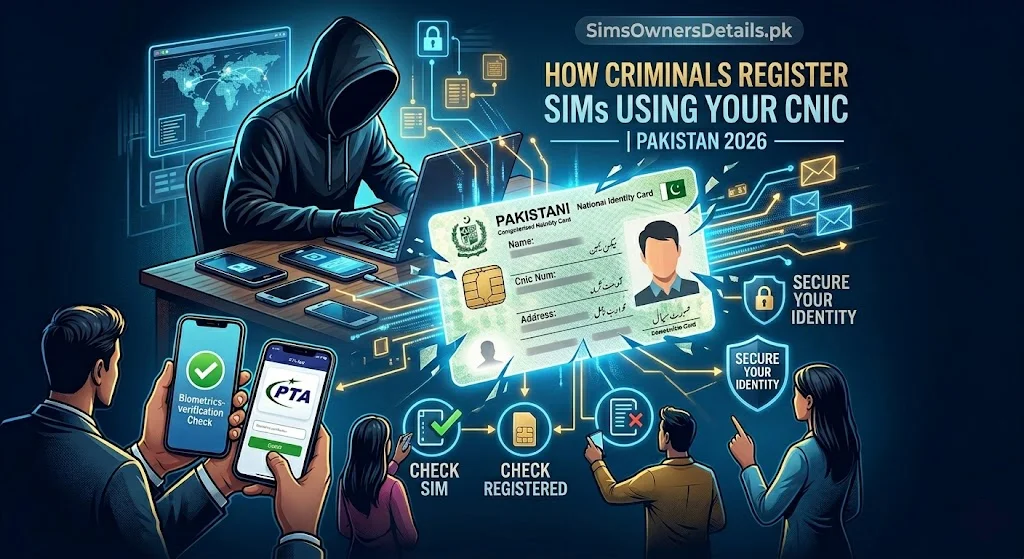
Every year, tens of thousands of Pakistanis discover that criminals have registered SIM cards using their CNIC — without their knowledge, without their presence, and sometimes without even having physical access to their CNIC card. The consequences range from a consumed SIM slot to full financial ruin — drained bank accounts, hijacked mobile wallets, and legal complications from crimes committed under your identity.
Understanding the exact methods criminals use to fraudulently register SIMs on stolen or copied CNICs is not just interesting — it is your most powerful tool for prevention. When you know how the attack works, you know exactly which habits and precautions actually stop it.
This guide covers every documented method criminals use to register SIMs on Pakistani citizens’ CNICs, how each method exploits specific weaknesses in the registration system, and the precise countermeasures that block each attack vector.
Critical Stat: PTA’s own enforcement data shows that thousands of unauthorized SIM registrations are reported and blocked in Pakistan every month. The vast majority involve one of the six methods described in this guide — all of which are preventable.
Why Criminals Want SIMs Registered on Your CNIC
Before examining the methods, understanding the criminal motivation clarifies why this crime is so common:
Financial motivation — the primary driver: A SIM registered on your CNIC is a financial weapon. It can be used to:
- Receive OTPs for your JazzCash, Easypaisa, or bank account
- Execute a SIM swap attack to take over your financial accounts
- Open new JazzCash or Easypaisa accounts for money laundering
- Receive proceeds from phone scams in an untraceable (for the criminal) way
Untraceable communication: A SIM registered on your CNIC means all criminal calls trace back to you, not to the criminal. Scam call centres, drug networks, and extortion operations all use fraudulently registered SIMs to communicate with victims while maintaining plausible deniability.
CNIC quota exploitation: Your CNIC has 5 SIM slots. Criminals who consume your slots create a secondary crime — you cannot register new legitimate SIMs until the unauthorized ones are blocked, causing practical disruption that can be exploited.
Identity cover for organized crime: A SIM registered on your CNIC provides a real identity layer for criminal operations. Bank accounts, online seller accounts, and financial services opened under your identity have the legitimacy of a real CNIC holder — you.
Method 1: Photocopy Fraud — The Most Common Attack
How it works:
This is the single most widespread method for fraudulent SIM registration in Pakistan, responsible for the majority of unauthorized SIM cases.
The criminal obtains a photocopy of your CNIC — not the original, just a black-and-white or colour copy. They take this photocopy to a franchise that has low compliance standards or a corrupt employee. The employee visually verifies the photocopy, enters your CNIC number into the biometric terminal, but either:
- Uses a fingerprint spoof (see Method 3) to pass biometric
- Enters your CNIC data manually and marks biometric as “verified” without actually scanning
- Exploits a NADRA connectivity outage window when offline registration is possible
The criminal walks out with an active SIM registered on your CNIC.
Where criminals get your CNIC photocopy:
- Hotels — legally required to collect guest CNIC copies; these archives are targeted
- Banks — branch staff with access to KYC files
- Shops, offices, and services that collect CNIC copies for routine purposes
- Real estate offices — property transactions require CNIC copies
- Hospitals and clinics — patient registration
- Educational institutions — admission forms
- Lost wallets — your CNIC found and photographed before your wallet is returned
How to stop photocopy fraud:
The single most effective countermeasure is purpose-marking every CNIC photocopy you provide:
Write across every copy in pen — before handing it over — the following:
“For [specific purpose] only — [Date] — Not valid for any other use”
A purpose-marked photocopy is legally unusable for SIM registration because the visible marking makes the intent of submission documented. Any franchise that accepts a purpose-marked photocopy for SIM registration is committing a documented violation.
Additional protections:
- Request the return of your CNIC photocopy after its stated purpose is complete (e.g., after hotel check-in)
- Photograph any entity that takes your CNIC photocopy — create your own record
- Check 668 within 48 hours of providing any CNIC photocopy anywhere
Method 2: Corrupt Franchise Insider — The System Vulnerability
How it works:
A franchise employee with system access processes a SIM registration on your CNIC without your presence. This is an insider attack — the employee uses their terminal access to register a SIM, either for personal gain (selling the SIM) or as part of a criminal organization that pays franchise staff for registrations.
This method bypasses the biometric requirement through system manipulation — the employee marks a biometric verification as successful without actually completing the fingerprint scan, or uses a pre-recorded or simulated fingerprint in the terminal.
Why this method is particularly dangerous:
- No physical CNIC is needed in some cases — just your CNIC number (which can be obtained from any document bearing your number)
- The registration appears completely legitimate in PTA’s system
- The criminal gets a SIM that passes all standard verification checks
- Detection requires active monitoring via 668 or a franchise audit
How to stop insider fraud:
You cannot fully prevent insider fraud — it is a systemic vulnerability that PTA and operators must address through staff vetting and compliance monitoring. However, you can detect it faster:
- Check 668 monthly without fail — insider-registered SIMs appear immediately
- After providing your CNIC number to any business or institution, check 668 within 48 hours
- Report any franchise that you observe behaving suspiciously (accepting registrations without biometric, allowing registration for absent parties) to PTA at 0800-55055
What happens to convicted insider fraudsters: Under PECA 2016 Section 16, franchise employees who process unauthorized SIM registrations face up to 3 years imprisonment and Rs. 1 million fine. Additionally, the franchise’s PTA license can be revoked. These penalties exist because insider fraud is treated as one of the most serious forms of SIM fraud in Pakistan.
Method 3: Fake Fingerprint Mould — The Biometric Attack
How it works:
This is the most technically sophisticated method and, fortunately, the rarest. Criminals create a fake fingerprint mould — typically from gelatin or silicone — shaped to match your fingerprint. They use this mould on the biometric scanner at a franchise, fooling lower-quality scanners into registering a match against your NADRA fingerprint record.
How criminals obtain your fingerprint:
- Lifting prints from surfaces you have touched (glasses, documents, smooth surfaces)
- Elaborate scam operations where victims are tricked into pressing their fingers on fake “verification pads”
- Corrupt insiders at NADRA-adjacent processes who capture high-quality fingerprint impressions
Why this method is rare but serious: Creating a functional fingerprint mould requires technical skill and usually specific knowledge of which finger(s) produce a clean NADRA match for a given CNIC. The effort involved means this method is reserved for high-value targets — business owners, individuals with large mobile wallet balances, or people whose SIM is needed for a specific fraud operation.
How to stop fingerprint mould attacks:
At the individual level:
- Be suspicious of any process that asks you to press your finger on a pad outside a recognized, certified NADRA or franchise terminal
- Never participate in “biometric surveys,” “fingerprint verification drives,” or similar activities unless at a known government facility
- Report any suspicious fingerprint collection activity to PTA and NADRA
At the system level: PTA has been upgrading franchise biometric terminals to liveness-detection capable scanners — devices that can distinguish a live finger from a gelatin mould. As this upgrade rolls out across all franchises, this attack vector will be significantly reduced.
Method 4: Social Engineering — Stealing Your CNIC Data Over the Phone
How it works:
The criminal calls you posing as a representative of PTA, NADRA, your mobile operator, or your bank. They create a scenario requiring you to “verify” your CNIC number:
- “Your SIM is about to be blocked due to non-compliance — please verify your CNIC”
- “We are updating our records — please confirm your 13-digit CNIC number”
- “Your CNIC appears in a fraud alert — we need your number to clear your record”
Once they have your CNIC number, your name, and your mobile number — they have everything needed for a franchise-based or insider-assisted SIM registration.
Why this method works: PTA, NADRA, and operator communications use similar language to legitimate compliance campaigns. Criminals time their calls to coincide with actual PTA campaigns (which are widely publicized) to increase credibility.
How to stop social engineering:
The rule is absolute: No legitimate Pakistani government agency, operator, or bank will ever call you to ask for your CNIC number.
- PTA communicates via SMS to your registered number — not via inbound calls
- NADRA does not call citizens to request CNIC verification over the phone
- Your bank’s fraud team will ask you to call their official number — they do not initiate CNIC requests via inbound calls
When you receive any such call:
- Do not provide any information
- Hang up
- Call PTA at 0800-55055 to report the number
- Check 668 within the next hour
Method 5: Data Breach Exploitation — Your CNIC in Criminal Databases
How it works:
Pakistan has experienced multiple data breaches affecting NADRA records, voter databases, and telecom subscriber data. Criminal networks purchase this data on the dark web or from insider sources, obtaining CNIC numbers, names, addresses, and phone numbers for millions of Pakistanis.
With your complete CNIC data from a breach, criminals can:
- Attempt franchise registration using a printed fake CNIC
- Execute social engineering attacks with your personal details for added credibility
- Combine your data with other breached information to build a complete fraud profile
Why this is particularly insidious: You did nothing wrong. You did not share your CNIC improperly. But your data was compromised through an institution you trusted. You have no way of knowing your data was in a breach until a fraudulent SIM appears on your CNIC.
How to stop exploitation of your breached data:
You cannot prevent a data breach at an institution. But you can minimize damage:
- Monthly 668 checks catch fraudulent SIMs within 30 days of registration at most
- Acting within the first month prevents the criminal from fully exploiting a SIM
- If you have been a victim of a data breach (banks and operators are obligated to inform affected customers), immediately check 668 and check your financial accounts
For monitoring your SIM registration status and Pakistan’s latest SIM fraud trends, visit our complete Pakistan SIM database guide.
Method 6: Lost or Stolen CNIC — Physical Possession Attack
How it works:
This is the most straightforward method — the criminal physically has your CNIC card. With the original CNIC, they have the card number, your photograph, and everything needed to present at a franchise as you. The only barrier is biometric fingerprint matching — which they attempt to bypass using Methods 3 or through a corrupt franchise insider.
The danger window: The period between your CNIC being stolen and you reporting it to NADRA and PTA is the maximum risk window. During this time, the criminal has your CNIC and faces no system-level obstacles beyond biometric.
How to stop lost/stolen CNIC attacks: The moment you discover your CNIC is missing:
- Check 668 immediately
- Call NADRA at 051-111-786-100 to report it stolen
- File an FIR at the nearest police station
- Call PTA at 0800-55055
- Call your bank’s fraud line
Speed of response is the critical variable. Every hour of delay increases the criminal’s opportunity window.
The Complete Criminal Registration Process — From Theft to Fraud
Understanding the full attack chain helps you identify where to break it:
Stage 1 — Target selection: Criminals identify targets through data breaches, social engineering, or physical access to CNIC documents.
Stage 2 — CNIC acquisition: Photocopy, original card theft, data breach, or social engineering provides the criminal with your CNIC information.
Stage 3 — Franchise selection: The criminal identifies a franchise with low compliance — typically smaller, non-corporate outlets or those in low-surveillance areas.
Stage 4 — Registration: Using one of the six methods above, the criminal registers a SIM on your CNIC. The SIM appears in PTA’s database within 30–60 minutes.
Stage 5 — Exploitation: The registered SIM is used for financial fraud, scam operations, or SIM swap attacks within hours of registration.
Stage 6 — Abandonment: After exploitation, the criminal abandons or deactivates the SIM to reduce traceability. Your CNIC slot remains consumed.
Where you can break the chain:
- Stage 2: Protect every CNIC photocopy — purpose-mark all copies
- Stage 4: Regular 668 monitoring catches registration within 30 days
- Stage 5: Immediate action when 668 shows unauthorized SIM — report before exploitation begins
For ongoing SIM registration monitoring and Pakistan’s most comprehensive fraud detection resource, use the tools at simsownersdetails.pk/live-tracker/.
High-Risk Situations — When to Check 668 Immediately
These specific situations dramatically elevate your risk of criminal SIM registration:
| High-Risk Event | Check 668 Within |
|---|---|
| Provided CNIC photocopy to any business | 48 hours |
| Lost your wallet (even temporarily) | Immediately |
| CNIC physically stolen | Immediately |
| Received suspicious call requesting CNIC info | 1 hour |
| Visited a non-branded mobile franchise | 24 hours |
| Stayed at a hotel (mandatory CNIC collection) | 48 hours |
| Filed a job application requiring CNIC copy | 48 hours |
| Underwent hospital/clinic registration | 48 hours |
| Signed a property document | 24 hours |
| Heard of a data breach at an institution you use | Immediately |
Frequently Asked Questions
Q: Can a criminal register a SIM on my CNIC without having my physical CNIC card?
A: Yes — Methods 1, 2, 4, and 5 all operate without the physical card. A photocopy, your CNIC number alone (for insider attacks), social engineering, or data breach data are all sufficient depending on the method used.
Q: If I report an unauthorized SIM to PTA, will the criminal know I reported it?
A: No. The SIM is simply blocked — the criminal’s SIM stops working without notification of why. PTA’s investigation is conducted without alerting the subject.
Q: How quickly after registration can a criminal start using a fraudulently registered SIM?
A: A new SIM is typically active within minutes of biometric registration at a franchise. A criminal can start using it for calls and OTP interception within 30 minutes of registration.
Q: Is it legal for hotels and hospitals to collect CNIC photocopies?
A: Yes — CNIC collection is legally mandated for hotels under Pakistan’s guest registration laws and for various regulated industries. However, these institutions are responsible for the security of your data. Misuse by their staff is a PECA 2016 violation.
Q: If a criminal registers a SIM on my CNIC and commits a crime with it, am I liable?
A: Your liability is significantly reduced if you have a filed FIR and PTA complaint establishing that you reported the unauthorized SIM. This is why immediate reporting is critical — it creates your legal defense record.
Q: What is the most effective single action I can take to prevent SIM fraud?
A: Monthly 668 checks. This single habit — sending your CNIC to 668 once a month — catches unauthorized registrations before they can be fully exploited in the vast majority of cases.
Q: Can I sue a franchise that registered a SIM on my CNIC fraudulently?
A: Yes. Under PECA 2016 and consumer protection laws, you can pursue both criminal charges (through FIA) and civil compensation claims against franchise operators whose employees participated in or facilitated unauthorized SIM registration on your CNIC.
Q: Does PTA track which franchise registered a fraudulent SIM?
A: Yes. PTA’s database records the franchise ID for every SIM registration. This is why in-person franchise visits to investigate unauthorized SIMs are valuable — the registration origin is on record and is used in prosecutions.
Your Complete Prevention Checklist
- Check 668 every month — screenshot and save the results
- Purpose-mark every CNIC photocopy: “For [purpose] — [date]”
- Never share CNIC number over incoming phone calls
- Check 668 within 48 hours of any CNIC sharing event
- Add SIM lock PIN to all operator accounts (Jazz 111, Zong 310, Telenor 345, Ufone 333)
- Register email alerts on all financial apps linked to your SIM
- Report any suspicious SIM franchise activity to PTA 0800-55055
- Check family members’ CNICs monthly — especially elderly relatives and children
Visit simsownersdetails.pk for Pakistan’s most complete SIM fraud prevention and verification resource library.
Related Guide:
 SIM OWNER DETAILS