
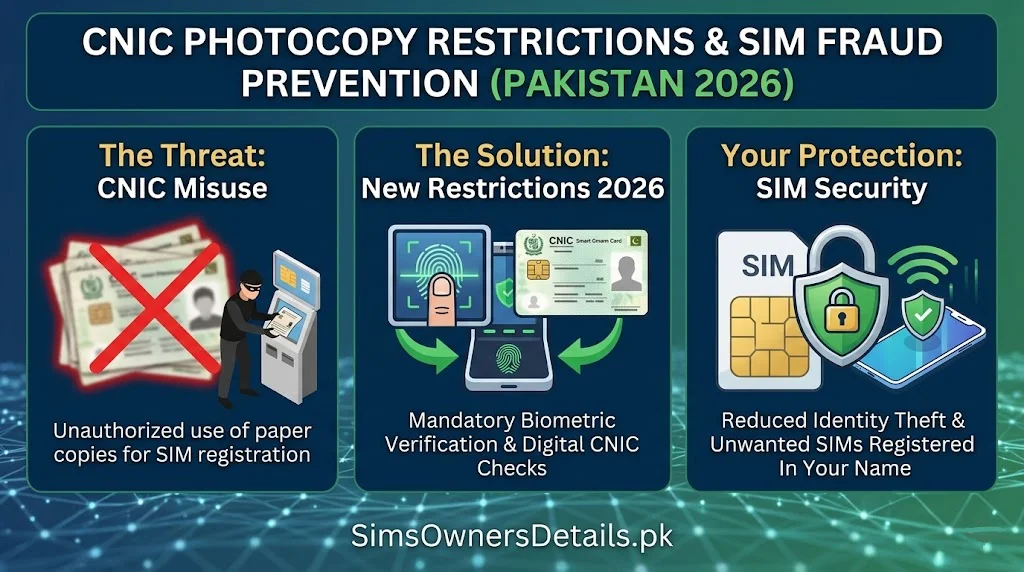
Your CNIC photocopy is the most exploited document in Pakistan’s SIM fraud ecosystem. A single photocopy of your national identity card — handed to a hotel, a bank, a shop, or any institution — can end up in criminal hands and be used to register SIMs on your CNIC within hours. Pakistan’s legal framework, regulatory guidance from PTA and NADRA, and evolving best practices all recognize CNIC photocopy misuse as a primary fraud enabler and have established specific restrictions and protections around how photocopies must be handled.
This guide explains exactly what the legal and regulatory restrictions on CNIC photocopies are in Pakistan, how purpose-marking works as a legal protection, what institutions are legally permitted to collect your CNIC copy, and what action you can take when a photocopy is misused for SIM registration.
The Single Most Important Habit: Before handing any CNIC photocopy to anyone — write across it in pen: “For [specific purpose] only — [Date].” This one habit, applied consistently, eliminates photocopy-based SIM fraud from your risk profile.
Why CNIC Photocopies Are the Primary SIM Fraud Vector
Of all the methods criminals use to fraudulently register SIMs on Pakistani citizens’ CNICs, photocopy-based fraud is responsible for the largest share of reported cases. The reason is simple: CNIC photocopies are ubiquitous.
Every hotel in Pakistan is legally required to collect CNIC photocopies from guests. Banks collect them for account opening. Employers collect them for HR records. Landlords collect them for tenancy agreements. Hospitals, schools, government offices, vehicle registration offices — all collect CNIC photocopies as a routine matter.
This creates a massive ecosystem of stored CNIC copies spread across thousands of institutions, accessible to hundreds of thousands of employees — each of whom represents a potential fraud vector. A corrupt hotel employee, a disgruntled bank clerk, a negligent office manager whose files are stolen — any of these can result in your CNIC photocopy reaching criminal hands.
The scale of CNIC photocopy collection in Pakistan means that virtually every adult Pakistani citizen’s CNIC copy exists in multiple places simultaneously. Without active protection measures, this creates permanent ongoing exposure.
For a complete understanding of how your CNIC connects to SIM fraud risk and what official verification tools are available, visit our CNIC information guide.
Who Is Legally Permitted to Collect Your CNIC Photocopy in Pakistan
Not every entity that asks for your CNIC photocopy has a legal right to demand it. Understanding legitimate vs illegitimate requests helps you identify when to push back:
Legally Mandated CNIC Collection:
Hotels and guest houses: Under Pakistan’s Hotel and Restaurant Act and security directives, hotels are legally required to register guests’ CNIC details. Collection of a photocopy is standard practice. However, hotels are obligated to store this data securely — a data breach from hotel records is the hotel’s legal liability.
Banks and financial institutions: Know Your Customer (KYC) requirements under State Bank of Pakistan regulations mandate CNIC collection for account opening, loan applications, and other financial services.
Telecom operators: PTA mandates CNIC collection and biometric verification for SIM registration. This is fully legal and regulated.
Government offices: Various government departments collect CNIC copies for official processes — property registration, vehicle registration, court filings, and many others.
Employers: Labor law and taxation requirements mean employers can legitimately collect CNIC copies for payroll, tax records, and employment documentation.
NOT Legally Required to Collect Your CNIC:
Retail shops for routine purchases: A shop selling you groceries, electronics, or clothing has no legal basis to demand your CNIC photocopy.
Social media platforms or online services: Pakistani online services asking for CNIC photocopy uploads without clear legal or regulatory justification should be treated with suspicion.
Unregistered individuals: Private individuals — landlords, employers in the informal sector, market traders — who request your CNIC without being part of a regulated industry.
When in doubt: Ask why your CNIC is required, what it will be used for, how it will be stored, and who will have access. A legitimate institution can answer all these questions clearly.
The Legal Framework Around CNIC Photocopy Misuse in Pakistan
Several laws and regulations govern how CNIC photocopies must be handled and what constitutes illegal use:
PECA 2016 — Sections 14 and 16:
Using a CNIC photocopy to register a SIM without the CNIC holder’s consent is a criminal offence under both Section 14 (unauthorized use of identity information) and Section 16 (unauthorized SIM issuance). This applies equally to the person who presents the photocopy fraudulently AND to the franchise employee who processes the registration.
Penalties: Up to 3 years imprisonment and Rs. 5 million fine under Section 14.
NADRA’s Data Protection Guidelines:
NADRA has issued guidelines (not yet formalized as legislation in all respects) requiring institutions that collect CNIC copies to:
- Store them securely with access controls
- Use them only for the stated purpose
- Destroy them when no longer needed
- Not share them with third parties without consent
Violations of these guidelines can be reported to NADRA and may constitute a breach of existing data protection provisions.
PTA Consumer Protection Regulations:
PTA regulations on SIM registration require franchises to use only current, biometrically verified CNIC data — not photocopy-based registrations. Any franchise that registers a SIM based on photocopy alone (without live biometric) is in violation of PTA’s own franchising conditions, which can result in franchise license revocation.
Pakistan Penal Code — Sections on Fraud and Forgery:
Using a CNIC photocopy with altered details, or presenting a photocopy in a context where it deceives another party, can also attract charges under PPC sections on fraud and forgery.
How Purpose-Marking a CNIC Photocopy Protects You — Legally and Practically
Purpose-marking is the act of writing on your CNIC photocopy before handing it over, specifying its sole permitted use. This is the most universally recommended CNIC protection practice by PTA, NADRA consumer guidance, and digital security experts in Pakistan.
The Correct Format for Purpose-Marking:
Write clearly in ink across the face of the photocopy:
“For [specific purpose] only — [Date] — Not valid for any other use”
Examples:
- “For Marriott Hotel check-in only — 15 May 2026 — Not valid for any other use”
- “For MCB Bank account opening only — 20 May 2026 — Not valid for any other use”
- “For XYZ Company employment record only — 1 June 2026 — Not valid for any other use”
Why This Works — The Legal Mechanism:
A purpose-marked CNIC photocopy creates a documented intent that is visible on the face of the document. If this photocopy is subsequently used for SIM registration:
- The photocopy itself is evidence that it was not authorized for SIM registration
- The franchise that accepted a photocopy marked for another purpose cannot claim ignorance
- The criminal who presented it knew the stated purpose was different — establishing mens rea (criminal intent)
- You, as the CNIC holder, have clear documentation that you authorized only one specific use
This paper trail significantly strengthens your PECA 2016 complaint and makes prosecution of the offending parties more straightforward.
What Purpose-Marking Does NOT Protect Against:
Purpose-marking is effective against franchise-level misuse but does not address:
- Digital copies of your CNIC (photographs, scanned files sent electronically)
- Social engineering attacks (criminals who know your CNIC number without needing the photocopy)
- Data breach exploitation (your CNIC data from hacked institutional databases)
For these risks, additional layers of protection — monthly 668 monitoring, SIM lock PINs, and email alerts on financial accounts — are required.
Step-by-Step: How to Handle CNIC Photocopies Safely in Every Common Situation
At a Hotel:
Step 1: When asked for your CNIC copy, write across it: “For [Hotel Name] check-in only — [Date]”
Step 2: Provide only the purpose-marked copy.
Step 3: Photograph the copy you provided (for your own record) before handing it over.
Step 4: Check 668 within 48 hours of check-in.
Step 5: If you have a long stay, check 668 again on checkout.
At a Bank:
Step 1: Purpose-mark: “For [Bank Name] account opening — [Date]”
Step 2: Ask the bank representative to sign or stamp the photocopy acknowledging its purpose (some banks do this as standard practice).
Step 3: Request confirmation of how the photocopy will be stored and when it will be destroyed.
Step 4: Check 668 within 48 hours of submission.
For Employment:
Step 1: Purpose-mark: “For [Company Name] employment record — [Date]”
Step 2: Confirm the HR department’s data security policy for CNIC records.
Step 3: Request copies are destroyed if employment does not proceed.
For Property Rental:
Step 1: Purpose-mark: “For [Landlord Name / Property Address] tenancy record — [Date]”
Step 2: Both parties can exchange purpose-marked copies — landlord’s CNIC marked for tenant record, tenant’s CNIC marked for landlord record.
Step 3: Check 668 within 48 hours.
Digital CNIC Copies — A Growing Risk in 2026
As more services in Pakistan move online, digital CNIC copies present new risks:
Risks of Sharing CNIC Photos Digitally:
WhatsApp sharing: Sending your CNIC photograph via WhatsApp creates a copy in the recipient’s gallery, their backup, and potentially on WhatsApp’s servers. Once shared, you cannot control it.
Email attachments: Emailed CNIC copies exist in email servers and backups beyond your control.
Online form uploads: Many Pakistani websites request CNIC photo uploads for verification. If the website is poorly secured, this data can be breached.
Video call screen sharing: Showing your CNIC on a video call means the caller can screenshot it without your knowledge.
Safer Digital Sharing Practices:
- Watermark digital copies: Before sharing any digital CNIC image, add a visible watermark in a photo editing app: “For [purpose] only — [Date]” — the same principle as physical purpose-marking.
- Use low-resolution images when digital submission is required — sufficient for identity verification but poor quality for printing a fake CNIC.
- Request secure portals: Legitimate institutions (banks, government agencies) should provide secure file upload portals rather than asking you to send CNIC photos via personal messaging.
- Revoke WhatsApp cloud backup of sent images after submitting to ensure your CNIC photo does not permanently reside in cloud storage.
What to Do If Your CNIC Photocopy Was Misused for SIM Fraud
If your 668 check reveals an unauthorized SIM registered after you provided a photocopy to an institution:
Step 1: Screenshot your 668 result — timestamped evidence of the unauthorized SIM.
Step 2: Identify the likely source — which institution(s) received your photocopy in the period before the unauthorized SIM appeared? Your purpose-marked copy documentation will be critical here.
Step 3: Contact PTA at 0800-55055 — report the unauthorized SIM and the suspected source franchise.
Step 4: Contact the institution — inform the institution (hotel, bank, etc.) that their CNIC copies appear to have been misused. Request their internal investigation records.
Step 5: File FIR at police station — include the identity of the institution whose records were likely accessed.
Step 6: File with FIA Cybercrime — if the institution was complicit or negligent, FIA can investigate data handling violations alongside the SIM fraud.
Step 7: Consult a lawyer — if the institutional data breach caused you financial damage, you may have grounds for civil compensation against the institution.
For SIM monitoring tools and official verification resources, visit our SIM information guide.
Frequently Asked Questions — CNIC Photocopy Restrictions Pakistan
Q: Is purpose-marking my CNIC photocopy a legal requirement or just a recommendation?
A: Purpose-marking is currently a best-practice recommendation from PTA and consumer protection advocates — not a formal legal requirement imposed on citizens. However, it has legal effect as evidence in PECA 2016 cases and significantly strengthens your protection if your photocopy is misused.
Q: Can a hotel refuse to accept a purpose-marked CNIC photocopy?
A: No legitimate hotel should refuse a purpose-marked photocopy — the marking does not affect the copy’s validity for guest registration purposes. If a hotel refuses, this is itself a red flag worth reporting to the relevant tourism authority.
Q: What if I already gave CNIC copies without purpose-marking in the past?
A: Start the habit from now. Check 668 immediately and monthly going forward. For high-risk past submissions (hotels, unverified employers, real estate agents), check 668 more frequently in the near term.
Q: Should I keep a record of every place I give my CNIC photocopy?
A: Yes — maintaining a simple log (institution name, date, purpose) creates a reference if you need to investigate a future unauthorized SIM. Your photos of purpose-marked copies serve this function if you photograph before handing over.
Q: Is a digital watermark as effective as a physical purpose-mark?
A: For digital copies, watermarking is the equivalent and is equally effective as evidence. Use photo editing tools to add visible, text-based watermarks across the face of the CNIC image before digital sharing.
Q: Can an institution legally sell or share my CNIC photocopy with a third party?
A: No. Under existing data protection guidance from NADRA and privacy principles, institutions that collect CNIC photocopies for a stated purpose cannot legally share them for other purposes without your consent. Any such sharing constitutes misuse of your personal data.
Q: If I report a hotel or business for misusing my CNIC photocopy, can they face penalties?
A: Yes. Institutional misuse of CNIC data enabling SIM fraud is actionable under PECA 2016. FIA can investigate institutional actors, and PTA can take action against any franchise found to have registered SIMs using misappropriated CNIC photocopies.
Q: What about CNIC copies I provided years ago — are they still a risk?
A: Potentially yes. Archived CNIC copies in institutional records remain a risk for as long as they are stored. There is no automatic expiry. This is why ongoing 668 monitoring is essential — a photocopy from years ago can be misused today.
Summary — CNIC Photocopy Protection in Pakistan
| Protection Action | Effectiveness | Effort |
|---|---|---|
| Purpose-mark every photocopy | High | Low |
| Photograph copy before handing over | High | Low |
| Check 668 within 48 hrs of sharing | High | Low |
| Watermark digital CNIC images | High | Medium |
| Request photocopy destruction after use | Medium | Low |
| Maintain sharing log | Medium | Low |
| Monthly 668 monitoring | Very High | Very Low |
Your CNIC photocopy is a powerful document — treat it like cash. Every copy you hand over should be purpose-marked, documented, and followed up with a 668 check. This single consistent habit is the most practical protection against Pakistan’s most common SIM fraud method.
For complete SIM verification tools and Pakistan’s most comprehensive CNIC and mobile identity security resource, visit Sim Owner Details.
Related Guide:
- How Criminals Register SIMs Using Your CNIC — And How to Stop Them Pakistan 2026
- CNIC Stolen in Pakistan 2026 — Immediately Protect Your SIMs Complete Guide
- Biometric SIM Verification Pakistan 2026 — BVS Complete Status Check Guide
- PTA DIRBS System Explained — How Device Blocking Works in Pakistan 2026
 SIM OWNER DETAILS